
Does research involvement make a real difference to patient care? Should it influence your choice of a neurosurgery practice?
We would say, yes. We believe research and clinical practice inform and strengthen one another, benefitting both patients and clinicians.
Integrating research at Macquarie Neurosurgery and Spine
At Macquarie Neurosurgery and Spine, research is woven into our practice, rather than seen as a separate activity.
As part of Macquarie University Health, we work within Australia’s first fully integrated academic health sciences centre, where clinical care, teaching and research are designed to inform one another. It means the specialist care we offer is shaped by current evidence, active clinical questions and ongoing scientific review.
Our research has helped pioneer new approaches in radiosurgery, neuroimaging, AI-assisted analysis and surgical planning, supporting more precise and informed neurosurgical care.
In recent years, our studies have addressed many questions directly relevant to neurosurgical care. Published in prestigious peer-reviewed journals, our research has explored:
- deep learning and hyperspectral imaging in brain tumour surgery
- artificial intelligence in brain tumours
- computational modelling in skull base surgery
- large language models in neurosurgery.
Together, these projects show a department engaged with both the biological questions behind disease and the technological advances that may support more precise treatment. They also show a clear commitment to improving how care is planned, delivered and refined over time.
What does research tell us about the benefits of research?
Research involvement does not mean your care becomes experimental or that your doctor is distracted by academic work. The evidence suggests something more meaningful: research-active settings often have stronger systems of care, closer adherence to evidence-based practice, and a clinical culture that supports more rigorous decision-making. These factors can improve patient outcomes.
A 2015 study of English NHS Trusts found that hospitals with higher research activity had lower risk-adjusted mortality for acute admissions, even after adjustment for staffing and structural factors. A large JAMA study of more than 21 million Medicare hospitalisations also reported lower 30-day mortality in major teaching hospitals compared with non-teaching hospitals.
There is relevant evidence in neurosurgery too. A study in the Journal of Neuro-Oncology found that teaching hospital status was associated with reduced inpatient mortality and fewer perioperative complications in surgical neuro-oncology, alongside a greater likelihood of routine discharge home. A 2023 study found that even community hospitals located in markets with a stronger academic medical centre presence had better outcomes, including lower mortality, suggesting that academic medicine can lift standards more broadly through shared expertise, training, systems and specialist networks.
What difference does this mean for our patients?
Our alliance with Macquarie University and Macquarie University Hospital creates a setting where clinical care, research and education are closely connected. That structure encourages constant review, peer discussion and refinement of technique. It also means our specialists are teaching, training and contributing to the ongoing development of neurosurgical practice.
For patients, this has a direct effect on the care pathway. Our research involvement creates a clinical environment where:
- clinicians are used to testing ideas and refining techniques
- complex cases are approached with subspecialist input
- new evidence is interpreted and implemented as it emerges
- complex questions are part of everyday discussions
- innovation is embraced when it is shown to enhance care.
Our research program includes work on brain aneurysms, brain AVMs, brain tumours, Gamma Knife radiosurgery, imaging, artificial intelligence, new surgical tools and pre-operative and intraoperative planning.
That breadth of research shapes patient care by:
- equipping us to understand where treatment standards are moving, which technologies are worth adopting, and how to judge whether a developing option is likely to add value in your case
- creating access to novel treatment pathways or clinical trial opportunities that are not widely available elsewhere
- providing confidence that established treatments are recommended because they still reflect the best evidence, rather than routine.
The importance of multidisciplinary care
Research is one part of high-complexity neurosurgical care. Collaboration is another.
We follow a patient-centred multidisciplinary model, working with radiologists, radiation oncologists, interventional neuroradiologists, medical oncologists, pathologists, psychologists and allied health professionals where appropriate. We also hold regular multidisciplinary meetings for complex cases so that risks, alternatives and treatment pathways can be reviewed in detail.
We do this because many neurological conditions require more than one perspective. A brain tumour may involve discussion of operative planning, pathology, radiotherapy and rehabilitation. Brain aneurysm treatment may require detailed vascular review and careful weighing of intervention against observation. Acoustic neuroma management often involves balancing tumour control with hearing, facial nerve function and long-term follow-up.
Access to precision technology
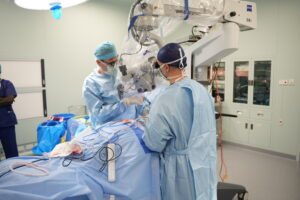
Through Macquarie University Hospital, we have access to intraoperative scans, high-resolution neurosurgical microscopes, state-of-the-art imaging and Australia’s first Gamma Knife radiosurgery unit. These technologies support precision in diagnosis, planning and treatment.
Gamma Knife is a form of stereotactic radiosurgery used for selected brain conditions, including brain tumours and acoustic neuroma. For appropriate patients, it can offer a highly targeted treatment option without invasive surgery. In the right clinical setting, stereotactic radiosurgery or stereotactic radiotherapy may broaden treatment options while supporting preservation of surrounding structures and function.
A more complete model of care
Neurosurgery has always required looking deeper, thinking further and continually refining what is possible for patients facing serious and often life-changing conditions.
Within a research-active, academically connected practice, that spirit of progress becomes part of everyday care, informing our questions, collaborations and treatment plans. It means patient care is shaped by evidence, specialist insight and a commitment to advancing neurosurgical care.
If that’s the kind of care you’d like to receive, please enquire about an appointment.
Disclaimer
All information is general and not intended as a substitute for professional advice. Any surgical or invasive procedure carries risks.
References
- Ozdemir, B. A., Karthikesalingam, A., Sinha, S., Poloniecki, J. D., Hinchliffe, R. J., Thompson, M. M., Holt, P. J. E., & Harrison, D. A. (2015). Research activity and the association with mortality. PLOS ONE, 10(2), e0118253. https://doi.org/10.1371/journal.pone.0118253, [Accessed 10 April 2026]
- Burke LG, Frakt AB, Khullar D, Orav EJ, Jha AK. Association Between Teaching Status and Mortality in US Hospitals. JAMA. 2017;317(20):2105–2113. doi:10.1001/jama.2017.5702, https://jamanetwork.com/journals/jama/fullarticle/2627971, [Accessed 10 April 2026]
- Luther, E.M., McCarthy, D., Berry, K.M. et al. Hospital teaching status associated with reduced inpatient mortality and perioperative complications in surgical neuro-oncology. J Neurooncol 146, 389–396 (2020). https://doi.org/10.1007/s11060-020-03395-x, [Accessed 10 April 2026]
- Burke LG, Burke RC, Orav EJ, Duggan CE, Figueroa JF, Jha AK. Association of Academic Medical Center Presence With Clinical Outcomes at Neighboring Community Hospitals Among Medicare Beneficiaries. JAMA Netw Open. 2023;6(2):e2254559. doi:10.1001/jamanetworkopen.2022.54559, https://jamanetwork.com/journals/jamanetworkopen/fullarticle/2800868, [Accessed 10 April 2026]