The nervous system is an extraordinary network that allows us to feel, move and respond to the world around us.
One of its important components is the trigeminal nerve, which helps us experience sensations such as touch, pressure, pain and temperature across the face.
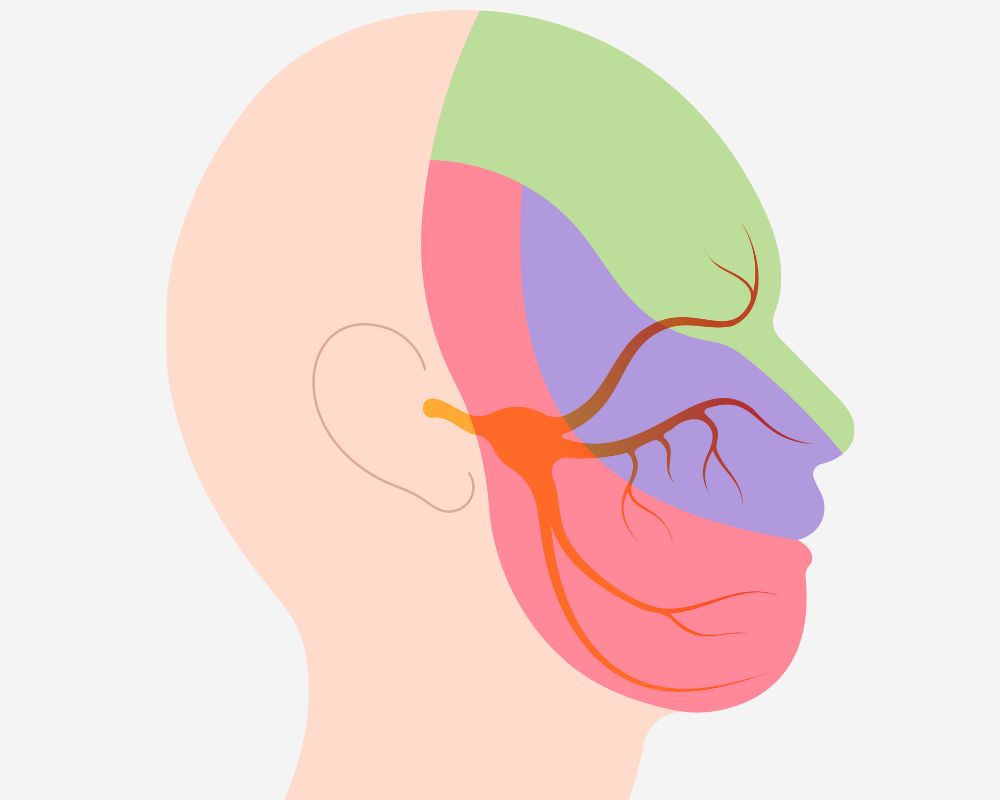
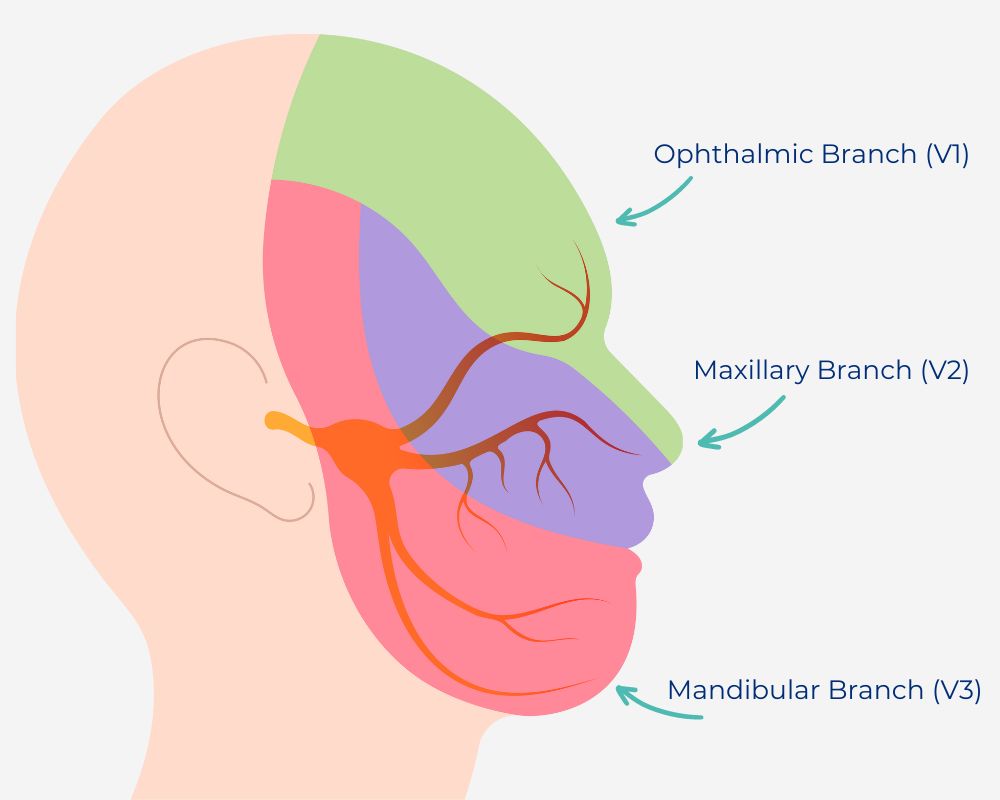
The trigeminal nerve has three main branches, known as the ophthalmic (V1), maxillary (V2) and mandibular (V3) branches. Each supplies a different area of the face, while the mandibular branch also plays a role in controlling the muscles used for chewing.
Understanding these branches can help explain how the trigeminal nerve works and why certain conditions may cause pain or changes in facial sensation.
Overview of the trigeminal nerve
The trigeminal nerve is the fifth (CN V) and largest of the 12 pairs of cranial nerves. One trigeminal nerve runs down the left side of the face while the other runs down the right side. The trigeminal nerve’s function is to provide sensation to the face and inside the mouth.
The trigeminal nerve carries sensory information from different regions of the face to the brain. It also has a motor component that helps control several muscles involved in chewing.
The nerve divides into three main branches, each serving a different region of the face. These are commonly referred to as V1, V2 and V3.
Trigeminal nerve branches
The trigeminal ganglion sits on the base of the skull just in front of the ear and behind the eye. From that point, the trigeminal nerve divides into three branches that supply the upper, middle, and lower parts of the face.
Ophthalmic branch (V1)
The ophthalmic (eye) branch is the upper division of the trigeminal nerve. It provides sensation to areas including the forehead, upper eyelid, cornea and upper part of the nose.
This branch is involved in sensing touch, pain and temperature in these regions. It also carries sensory information involved in the corneal reflex, which helps protect the eye.
Maxillary branch (V2)
The maxillary (upper jaw) branch is the middle division of the trigeminal nerve. It provides sensation to areas including the cheeks, lower eyelids, sides of the nose, upper lip, upper teeth and gums.
Like the ophthalmic branch, V2 is primarily responsible for sensation rather than movement.
Mandibular branch (V3)
The mandibular (lower jaw) branch is the lower division of the trigeminal nerve. It provides sensation to parts of the lower face, including the lower lip, chin, lower teeth and gums.
Unlike V1 and V2, the mandibular branch also contains motor fibres that help control the muscles responsible for chewing.
Trigeminal neuralgia
Because the trigeminal nerve provides sensation to much of the face, conditions affecting this nerve can cause significant facial pain.
One such condition is trigeminal neuralgia, which is characterised by episodes of intense, often electric shock-like pain affecting one or more areas supplied by the trigeminal nerve.
The symptoms and underlying causes can vary. Trigeminal neuralgia is generally classified into classical, secondary and idiopathic forms.
Classical trigeminal neuralgia
Classical trigeminal neuralgia can be diagnosed when:
- A patient experiences repeated attacks of one-sided facial pain
- There is evidence of an artery or vein compressing the nerve together with changes in the trigeminal nerve root itself (these may be detected on MRI or in surgery).
Many patients with classical trigeminal neuralgia can clearly remember when the pain began. There may be pain-free periods followed by a sudden recurrence of pain. In some patients, the pain is constant and does not go away.
Secondary trigeminal neuralgia
In this type, neuralgia occurs as a result of another underlying condition.
Patients may have:
- Persistent or recurrent one-sided facial pain
- An underlying condition such as:
- Multiple sclerosis
- Arteriovenous (AV) malformation – when the nerves and veins are abnormally tangled
- A tumour
- Damage caused by surgery.
Secondary trigeminal neuralgia may be diagnosed when that combination of factors exists and there is no other plausible explanation for the pain.
MRI may be useful in identifying the underlying condition. Doctors may also assess trigeminal reflexes.
Idiopathic trigeminal neuralgia
‘Idiopathic’ means a condition without a known cause.
Idiopathic trigeminal neuralgia may be diagnosed when:
- A patient experiences persistent or recurrent one-sided facial pain that meets the definition of trigeminal neuralgia
- Investigations have ruled out classical trigeminal neuralgia and secondary trigeminal neuralgia
- No other diagnosis fits the pattern of symptoms.
Diagnosing trigeminal neuralgia
Trigeminal neuralgia can be difficult to diagnose because there is no specific test to assess the health of the nerve.
Many conditions cause similar symptoms to trigeminal neuralgia. They can include:
- Sinus infections
- Cluster headaches
- Trigeminal neuropathic pain
- Temporomandibular joint syndrome
- Dental pain.
Patients are encouraged to seek medical care when experiencing facial pain, especially when they have not had recent dental or facial surgery. Healthcare professionals are encouraged to consider trigeminal nerve involvement in patients presenting with facial pain.
Diagnosing trigeminal neuralgia may involve:
- Obtaining a detailed medical history of how the pain feels, where it is located and what triggers it.
- An MRI scan to find out if anything is affecting the nerve
- A physical and neurological examination to explore the location of the pain
Treatments for trigeminal neuralgia
Treatment focuses on relieving pain and may include:
- Medications – several options are available, generally starting with low doses anti-epileptic drugs. (carbamazepine)
- Percutaneous procedures – these damage the nerve to reduce abnormal transmissions of sensation that cause the pain. Examples balloon compression, radiofrequency ablation.
- Radiosurgery – focused beam of radiotherapy performed in one setting. Which damages the nerve and reduces abnormal transmissions.
- Surgery – (Microvascular decompression) to remove or separate the offending artery or vein from the nerve.
It is important to remember that all treatments involve a trade-off between benefits and risks. These are important areas for discussion between patients and doctors.
Next steps
If you’re experiencing persistent or recurring facial pain, it’s important to speak with your GP. They can assess your symptoms, consider other possible causes and arrange further investigations or a referral when appropriate.
For more information, you can read about trigeminal neuralgia and hemifacial spasm.
If you have already received a referral and would like to enquire about an appointment with Macquarie Neurosurgery and Spine, please contact our team.
Healthcare professionals interested in further neurosurgical education can also explore our available workshops and training opportunities.
Disclaimer
All information is general and is not intended to be a substitute for professional medical advice. Macquarie Neurosurgery and Spine can consult with you to confirm if a particular treatment or procedure is right for you. Any surgical or invasive procedure carries risks. A second opinion may help you decide if a particular treatment is right for you.
References
- Huff T, Weisbrod LJ, Daly DT. Neuroanatomy, Cranial Nerve 5 (Trigeminal) [Updated 2022 Nov 9]. In: StatPearls [Internet]. Treasure Island (FL): StatPearls Publishing; 2023 Jan-. Available from: https://www.ncbi.nlm.nih.gov/books/NBK482283/, [Accessed 11 January 2024]
- Cleveland Clinic, Trigeminal nerve, https://my.clevelandclinic.org/health/body/21581-trigeminal-nerve, [Accessed 11 January 2024]
- Cleveland Clinic, Trigeminal neuralgia, https://my.clevelandclinic.org/health/diseases/15671-trigeminal-neuralgia-tn, [Accessed 11 January 2024]
- Multiple Sclerosis Trust, Trigeminal neuralgia, https://mstrust.org.uk/a-z/trigeminal-neuralgia#, [Accessed 11 January 2024]
- American Association of Neurological Surgeons, Trigeminal neuralgia, https://www.aans.org/Patients/Neurosurgical-Conditions-and-Treatments/Trigeminal-Neuralgia, [Accessed 11 January 2024]